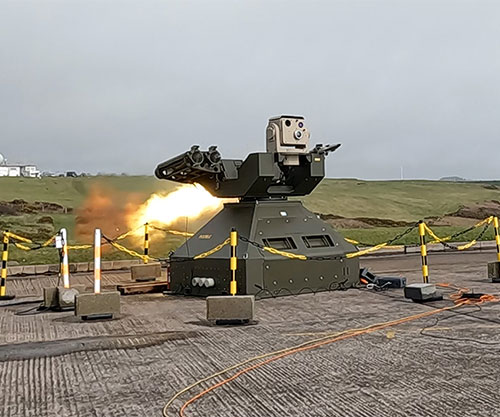





The UK Ambassador to Kuwait Qudsi Rasheed revealed that a world-leading UK Counter-Uncrewed Aerial System (C-UAS) was deployed to Kuwait between March 25 and 29.
The package includes Rapid Sentry and Lightweight Multirole Missiles (LMM), significantly enhancing Kuwait’s counter-drone capabilities. During a press conference on Wednesday, the ambassador explained that the deployed Rapid Sentry system provides a highly effective “hard kill” counter-drone capability, utilizing Thales UK’s Lightweight Multirole Missiles to neutralize aerial threats.
He added that the deployment features ORCUS+, a fully operational C-UAS capability that enables the detection, tracking, identification, and defeat (DTID) of uncrewed aerial systems, Kuwait News Agency (KUNA) reported.
Outlining the UK’s position, the Ambassador said his country has unequivocally condemned Iran’s attacks across the region. He stressed that the conflict is not the UK’s war. However, he noted that the UK could not ignore threats to British nationals, its interests, and its Gulf allies. As a result, the UK has undertaken specific, limited defensive measures to protect partners in the region, including Kuwait, but its role remains strictly defensive.
The Ambassador said: “British support to Kuwait’s defence is shown in three main areas. First, the UK has deployed counter-drone and counter-missile systems, including the “Rapid Sentry” capability, designed to protect Kuwaiti airspace from drone threats. Second, Royal Air Force specialists have been deployed to Kuwait to provide advisory support and training, including guidance on airspace management and counter-drone operations for Kuwaiti pilots.”
“Third, the longstanding British Military Mission in Kuwait, in place for more than three decades, continues to support and integrate with Kuwaiti forces, providing training and operational assistance. They have been in Kuwait for the last 34 years and have over 30 British personnel integrated into the Kuwaiti Armed Forces,” he continued:
The Ambassador noted that additional support is being explored in coordination with British defence companies, while some operational details remain undisclosed for security reasons. On the broader situation, he said the UK is pursuing a dual-track approach strengthening military defence for Gulf allies while pushing for a diplomatic resolution, stressing the need for de-escalation, and calling on Iran to halt attacks and allow the reopening of the Strait of Hormuz.
“The UK’s priority remains reducing tensions, restoring regional stability, and achieving a negotiated solution,” he said.
The UK Ambassador highlighted the ongoing high-level coordination between UK and Kuwaiti officials, including contacts between senior Ministers and leadership in both countries, underscoring close cooperation on both military and diplomatic fronts. (KUNA; File Photo: Rapid Sentry Air Defence System © RAF)