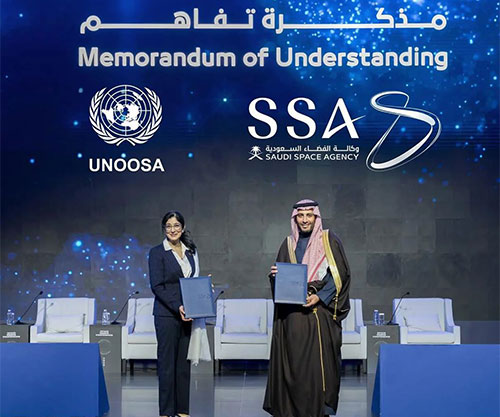





The Saudi Space Agency (SSA) signed a Memorandum of Understanding (MoU) with the United Nations, represented by the UN Office for Outer Space Affairs (UNOOSA) as part of efforts to enhance international cooperation, support initiatives aimed at space sustainability, and promote its responsible use.
The MoU, signed on the sidelines of the Space Debris 2026 Conference which took place in Riyadh, Saudi Arabia on 26-27 January, aims to establish a framework for cooperation between the two sides in areas of mutual interest related to the peaceful uses of outer space, in accordance with the rules, regulations, policies, and procedures applicable to both parties.
The Memorandum reflects a strategic direction to strengthen cooperation with the UN system, enhance coordination, and increase the effectiveness of existing partnerships, contributing to maximizing mutual benefits among relevant entities.
It also reinforces the Kingdom of Saudi Arabia’s role as an active and influential country in the space sector, serving its strategic interests and objectives at both the regional and international levels, the Saudi Press Agency (SPA) reported.
The MoU will facilitate the exchange of expertise, information, and technologies; the implementation of joint activities in priority areas; and the support of training programs and sustainable national capacity-building.
Areas of cooperation include supporting initiatives related to peaceful uses and space sustainability; building capacity in space science and engineering through education, training, research and development, and innovation; and exchanging expertise in space sciences, satellite technologies, and space exploration.
This MoU comes as part of SSA’s efforts to expand its international partnerships and strengthen the Kingdom’s contribution to global efforts aimed at ensuring the sustainability and peaceful use of outer space as a shared resource for humanity.
In a related development, the Saudi Space Agency announced on Tuesday the names of the winning teams of the global “DebriSolver” competition, one of the flagship initiatives accompanying the Space Debris Conference 2026.
Launched by the agency, the competition aims to stimulate scientific innovation and develop practical solutions to address space debris challenges, and enhance the sustainability of the near-Earth space environment. The competition was organized in partnership with several leading international organizations, including Slingshot Aerospace, LeoLabs, Astroscale, and Aldoria.
The competition attracted broad international participation, with more than 2,000 participants from over 40 countries. Competitors progressed through multiple competitive stages, resulting in the qualification of 20 teams for the final round.
The qualified teams presented advanced technical solutions addressing challenges in low Earth orbit, including space debris monitoring, prediction, and management using intelligent technologies. These solutions underwent rigorous scientific evaluation by a judging panel comprising 14 international experts, leading to the selection of four winning solutions based on criteria of innovation, readiness, and long-term impact on space safety and sustainability.
The Saudi Space Agency, together with its international partners, announced the four winning teams, representing diverse countries and areas of expertise. The winning teams included a team from India and the United States, a team from the Kingdom of Saudi Arabia, a team comprising participants from the United Kingdom, Germany, the Netherlands, France, and the United States, as well as a team from India, Greece, Tunisia, and Jordan.
The DebriSolver competition reflects the Kingdom’s commitment to supporting international space sustainability initiatives and strengthening joint efforts with global partners to protect space and ensure its sustainability as a shared resource for humanity.
The Saudi Space Agency is dedicated to achieving the Kingdom's ambitious vision of becoming a global leader in the space sector. It aims to contribute to local scientific and economic advancement through innovation and space exploration. The agency also focuses on strengthening international cooperation, developing national capabilities, fostering an environment that encourages innovation, and supporting investments in space sciences and exploration.